
'In the first meeting of this new year, we took a joint new year resolution that we will complete it this year. At the time things were not very clear, but the mood was clear that yes, we must resolve it.' 'Yes, details have to come out, but there are some sensitivities, there are some stake-holders not yet on board, especially other Naga undergrounds etc, we would like them to come on board... So at a proper time it has to be revealed to the country, and to the legislature. Perhaps, we may have to wait for some more time.' 'With better understanding of the Indian system, many of them have learnt, realised, appreciated that Naga nationalist aspirations can be accommodated in the Indian system. The Indian system is pretty comprehensive and flexible.' 'A Naga has as much stake, claim over India as any other Indian. There is no distinction. This, Nagas have realised, that yes, Naga nationalist aspirations and Indian nationalism are not mutually exclusive.' Ravindra Narayan Ravi, the Government of India's Special Interlocutor for the Naga talks, explains how the Naga Peace Accord was reached in an exclusive interview to Saisuresh Sivaswamy/Rediff.com

50 years after a cyclone wiped it out, Dhanushkodi is slowly finding its feet. A tourist attraction precisely for its desolateness, road connectivity could soon transform it. Saisuresh Sivaswamy, who spent a few hours there, comes back enchanted.

Louisiana Governor Piyush 'Bobby' Jindal may not have been among the top 10 Republican presidential hopefuls at the first GOP primary debate in Cleveland, Ohio. But he sure did make a strong pitch for his candidature, ripping apart President Barack Obama and forcefully putting across his thoughts on contentious issues like immigration and foreign policy.
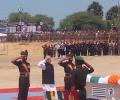
Does India's first majoritarian government that is hard-focused on economic development have it in it to provide the Muslim community the healing touch? On evidence available so far, I am not hopeful at all. Yet, like the besieged community, I too find it impossible to abandon hope in the land's millennia-old syncretic traditions, says Saisuresh Sivaswamy.
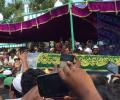
Thousands throng the narrow mohallas around the Mohideen Aandavar mosque in Rameswaram for A P J Abdul Kalam's Alvida Namaaz. Saisuresh Sivaswamy/Rediff.com reports from Rameswaram.
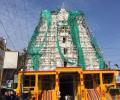
Keeping his secular credentials in mind and his love for all religions, a special prayer will be held at the Rameshwar temple and the Mohideen Aandavar Masjid.
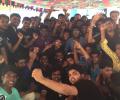
President Kalam was loved by the youth of India. Something evidenced by the mass of student volunteers who have arrived in Rameswaram to mourn and to help out other mourners who have arrived in the island town to pay their last homage to India's 'Missile Man.'
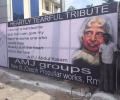
The city has lost its favourite son, A P J Abdul Kalam. But his his legacy will live on forever.
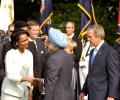
The night before Dr Singh was to meet President Bush, he said he could not sign the agreement.
'We had to convince our people that we were doing nothing that would erode our strategic programme. We were all the time arguing that we are not doing anything, which will remotely impact on our strategic programme.'

Aziz Haniffa/Rediff.com listens to four Indian and American national security advisers recalling the hard work that went into negotiating the nuclear deal.
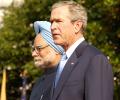
'If we could break through this symbolic barrier of sanctions and a dysfunctional relationship, we could do anything.'

'This is clearly a much stronger government, a much strong Prime Minister's Office and a much more disciplined approach. There is an improvement of the work culture in the government -- people don't play golf in the mornings anymore. There is a huge attempt going on to making business easier,' says Rakesh Mohan, executive director at the IMF.

'If you look at the relationship with Pakistan, or the relationship with China, both are today, more uncertain than they were when this government came into power.'
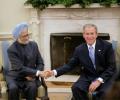
'The nuclear deal required Prime Minister Manmohan Singh to gamble the future of his government on a vision for the future of his nation.'
Rahul Gandhi has taken the fight to the Modi government, feels Milan Vaishnav. Aziz Haniffa/Rediff.com reports from Washington, DC.

Indian industry has accused Narendra Modi of not delivering, but he could not have delivered faster than he has done, argues Vikram Singh Mehta, Chairman, Brookings India. Aziz Haniffa/Rediff.com reports from Washington, DC.

The administration and America Inc have invested in Narendra Modi's power to transform India. Aziz Haniffa/Rediff.com reports from Washington, DC.
Even as India continues on the priority watch list of the Office of the US Trade Representative, strong voices from Washington, DC, have spoken out in favour of India, reports Aziz Haniffa/Rediff.com.
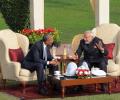
'When George Bush Senior decided in 1992 that India and the United States must start talking in this-now-changed world, who would have thought that 10, 15 years down the road, we will start looking at each other as strategic partners?'
 © 2025 Rediff.com - Investor Information - Advertise with us - Disclaimer - Privacy Policy - Sitemap - Feedback - About us - Terms of use - Grievances